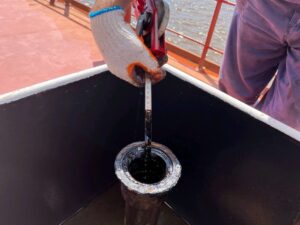
 During the period of the time charter, the Charterer provides the bunkers for the ship to use. These bunkers must be provided at the commencement of the charter, or the Charterer takes over the bunkers that are on board at the commencement or on delivery. When he returns the use of the ship to the owner (redelivery) the owner takes over the bunkers that are remaining on board.
A clause in the charterparty will ensure this transfer of “ownership” of the bunkers on board. This is the “Bunkers on delivery and redelivery clause”. Naturally, each party will want to state the quantity of bunkers on board at the appropriate time and disputes can arise, especially if there is no qualification in the “bunker clauses” specifying the price to be paid by each party for the bunkers on board
To minimise this source of dispute between the shipowner and the charterer, independent surveyors may be employed to carry out an on-hire survey on delivery and to carry out an off-hire survey on re-delivery. The surveyors will sound the tanks, calculate, and certify the fuel that is on board.
In addition to bunkers on delivery and redelivery surveyors could also be employed to survey the condition of the ship on delivery and redelivery.
In a time charter, the charterer is obliged to redeliver the vessel in “ . . . good order and condition, ordinary wear and tear excepted, to the Owners . . .”. The good order and condition must be the same as when the ship was delivered to the charterer. When the ship is delivered (“placed at the disposal of the Charterers”) it must be “ . . . ready to receive cargo with clean-swept holds and tight, staunch, strong and in every way fitted for the service . . . to be employed in carrying lawful merchandise . . .”
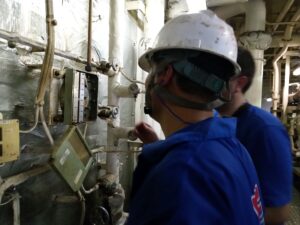 There are times wherein cases of hidden bunkers are flashed out. We provide services of detecting any hidden bunkers and reporting the same. As our surveyors are experienced and know the mal practices being carried out onboard some vessels to hide bunkers, our surveyors tactfully act and declare the actual quantities remaining onboard the vessels.
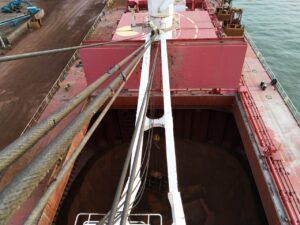 Protection and Indemnity cover is third party legal liability insurance for ship owners, operators, and charterers.
The principal risks covered are liabilities, costs, and expenses for:
- Injury, illness and death of crew, passengers, or other persons
- Cargo loss or damage
- Wreck removal
- Pollution
- Collision
- Dock damage
Fines or administrative penalties arising out of the operation or management of ships.
The Damage Survey is usually required by an insurance company to assess the extent of the injury to the vessel. It is also the job of the Damage Surveyor to ascertain the reasonable cost of repairs. If you do not have insurance, it is a very good idea to hire a surveyor as a project manager to help you mitigate the repairs to your vessel. A good surveyor will know which repair facilities can be relied upon and insure you will pay a reasonable price.
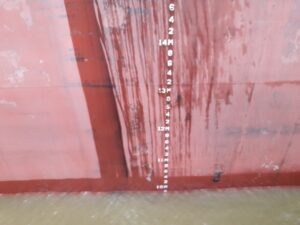 Draft surveys are made to determine the quantity of cargo loaded, carried, and discharged. This is done by measuring the vessels draft and calculating its displacement prior loading a cargo and after loading of this cargo, taking variables such as weight lightship, ballast water, fuel, and stores into account.
To obtain a reasonable accuracy in draft survey calculation corrections to the draft readings and its initial corresponding stability values and parameters must be made.
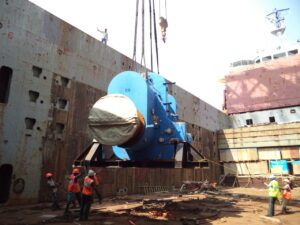 We provide independent third-party reviews and approvals of high value and/or high-risk marine construction and transportation project operations, from the planning stages through to the physical execution. This reduces the risk of loss or damage in high-value marine construction and transportation projects.
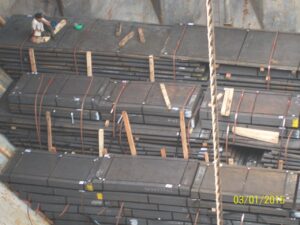 The service of pre-planning cargo packing/handling and stowage before vessel arrival to optimise safe and timely operations. Which in turn helps in minimising the risk of damage to cargo, vessel, and life. Correct cargo lashing enables safer handling for all operational staff. Vessel utilization can be maximised by proper pre-planning. Tidal and un-expected air-drafts are considered as part of the pre-planning to avoid loss of time and additional loader movements.
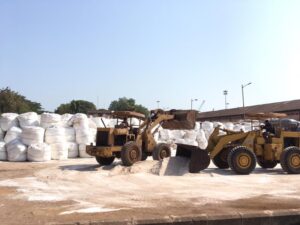 This is an important quality-control method for checking the quality of goods a client buys from a supplier before shipment.
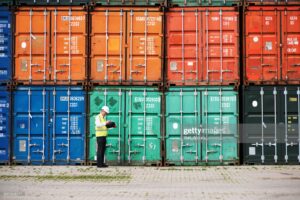
An ISO container inspection is a process of assessing the structural integrity of intermodal containers based on International Organization for Standardization (ISO) and Convention for Safe Containers (CSC) requirements
 Sampling of Concentrate cargoes as per IMSBC Code. Establish the quality & quantity of mines & minerals, sampling on lot basis, witnessing to analyses
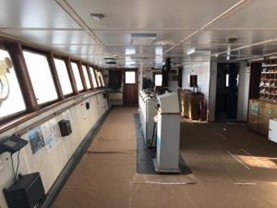 Depending on the request of the shipowner, reporting and identifying the existing shortage and damage with survey for ship to be purchased or rented, yachts, tugs, barges, platforms and all types of the vessel’s condition in related format, content with supporting photographs. The final survey of commercial vessels, yachts, tugs, barges, platforms and all types of scrap vessel’s which will not be executed as of age or for other reasons (beyond repair, hull and machinery failures) for the determination of salvage value and reporting in related format
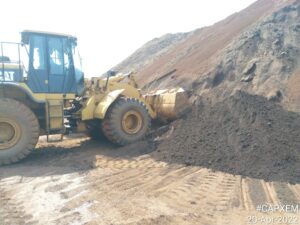
 Sampling of the cargo of Iron ore at the stockpiles, ship’s holds and barges. Sampling of Iron ore stockpiles, ship’s holds and barges are sampled strictly as per requirements of the IMSBC code Sec 4 and IS 1405. The procedure of sampling are carried out in controlled conditions and under strict supervision.
Can testing of the cargo of Iron ore at the stockpiles, ship’s holds and the barges: Can testing of cargo in case of Iron ore fine is carried out in compliance as per requirements of the IMSBC code Sec 8.4. Can testing is carried out to determine quickly the presence of moisture in the cargo.
Testing of the cargo to determine the Moisture, FMP & TML: On completion of the sampling as per the IMSBC code, a true representative sample is prepared and subjected to a laboratory test to determine for Moisture, FMP & TML.
P&I representations onboard in order to safeguard the Owners / Charterers to ensure that the cargo loaded onboard is safe for sea carriage: The P&I clubs appoint their local correspondents who in turn appoint local P&I surveyors to ensure that the cargo onboard their clients vessels.
Sampling the cargo at the barge loading jetties and carrying out can test to ensure the moisture content in the cargo to be loaded. We carry out sampling at the barge loading jetties to ensure that the cargo loaded in the barges is safe.
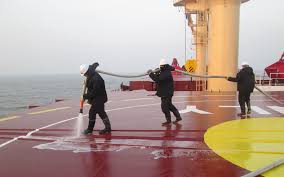
 To control the hatches of the ship and to make ultrasonic imperiousness tests of the hatches in a case of necessity, recommendation to the master of the ship, if there is a problem and to follow the elimination of the problem.
If it is possible, to control the condition in the factory or depot where the cargo is stacked before loading, to advise the loader to change the damaged cargo with new ones. To control imperiousness of hatches and to make necessary test flowing the loading of cargo.